
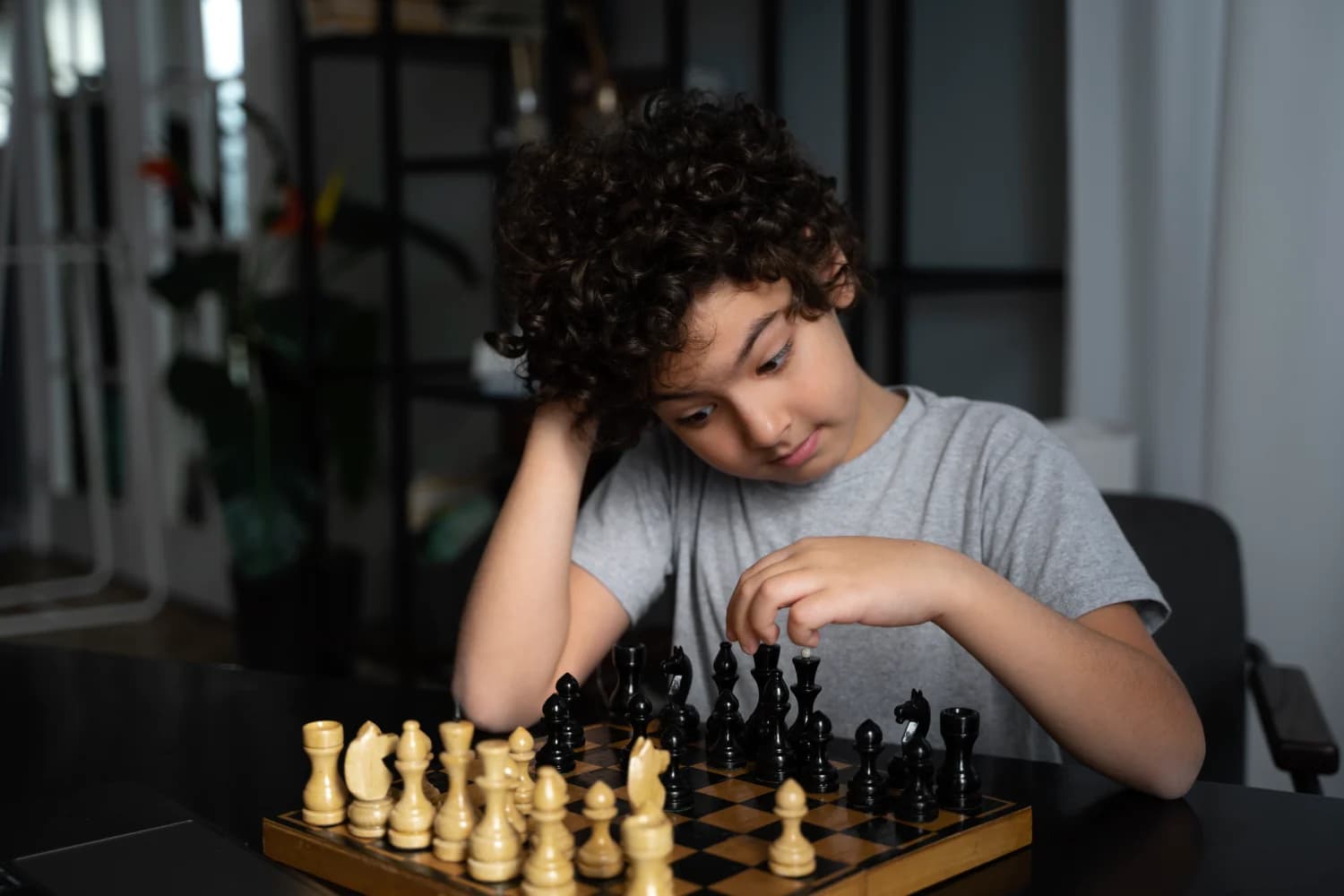
Chess has been played for over 1,500 years, but only in recent decades have scientists begun to fully understand why it is one of the most powerful cognitive tools ever devised. For children, learning chess doesn't just teach a game — it rewires the brain.
Research consistently shows that children who play chess demonstrate measurable improvements in mathematics, reading comprehension, and problem-solving. A landmark study of 4,000 students found that chess players improved their math test scores by 17.3% compared to non-players in the same period. But the benefits go far deeper than grades.
Critical Thinking and Planning
Every chess move requires a child to evaluate multiple possibilities, anticipate consequences, and commit to a plan under uncertainty. This is precisely the kind of thinking that educators call "executive function" — and it is the same skill set that predicts academic success, career achievement, and even emotional resilience in adulthood.
When a child asks "if I move here, what happens next?", they are practising multi-step reasoning. Do this three times a week for a year, and the habit becomes automatic — they start doing it in classrooms, in social situations, and eventually in every major decision they face.
Concentration and Focus
In an era of smartphones and instant gratification, concentration is increasingly rare — and increasingly valuable. A chess game demands sustained, deep focus for 30 to 90 minutes at a time. Children who practise this regularly develop an attention span that stands out in every setting.
Parents at Chaturangveda frequently report that their children's teachers noticed improved focus in class — not just in chess sessions. The game trains the brain to stay present, resist distraction, and return to the task at hand.
Emotional Intelligence and Resilience
Chess teaches children to lose gracefully. Every player — even grandmasters — loses games regularly. Learning to analyse a defeat without despair, to find lessons in failure, and to come back to the board with fresh energy is one of the most valuable life skills chess provides.
Equally, winning graciously — acknowledging an opponent's good moves, shaking hands, and not gloating — teaches the sportsmanship that forms the foundation of character.